Missions and launches
Hera begins braking maneuvers to reach the Didymos asteroids
ESA's Hera probe begins braking maneuvers on October 15 with a 93-minute burn to reach the Didymos asteroids and study DART's impact.
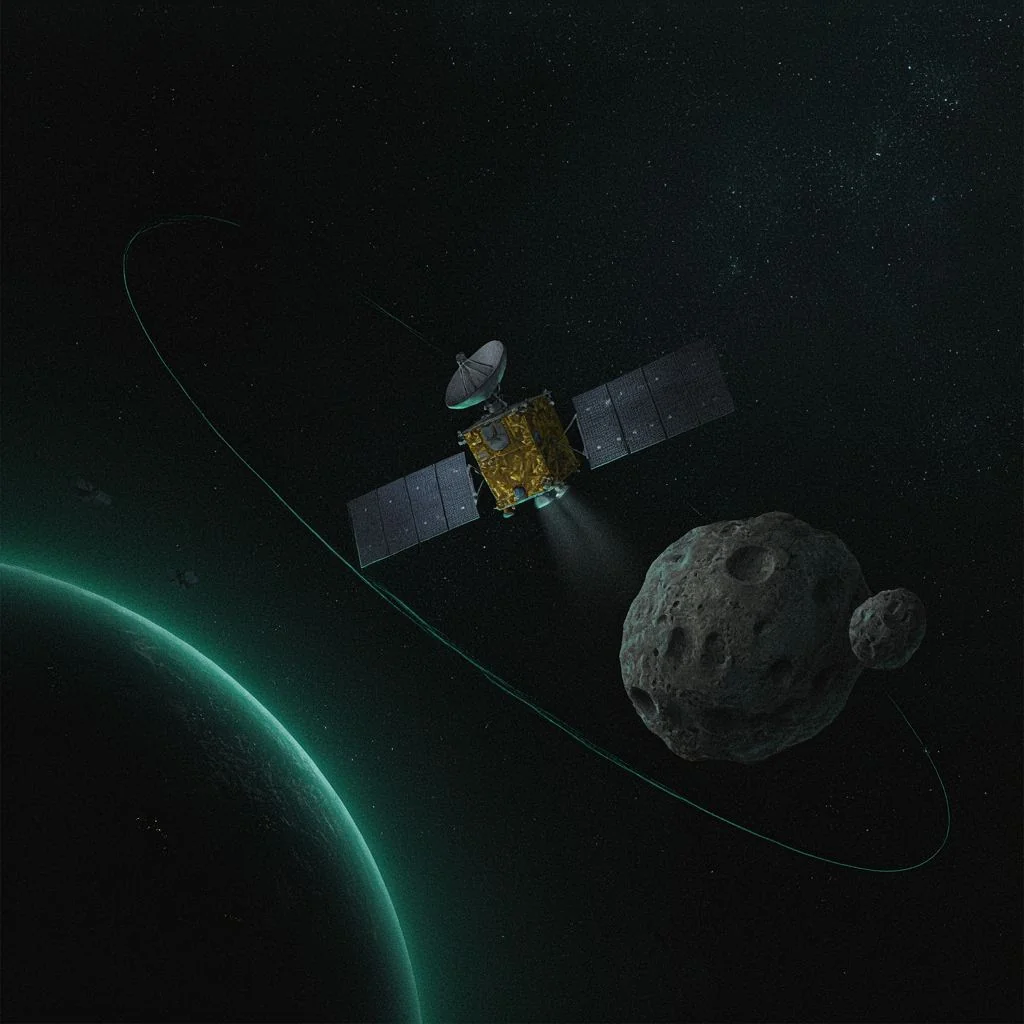
In brief
Two years after launch, ESA's Hera probe is braking to reach the asteroids Didymos and Dimorphos: the main maneuver, on October 15, 2026, will fire three hydrazine thrusters for 93 minutes, followed by a second braking burn of 31 minutes on October 22.
Key points
- Hera was launched on October 7, 2024 from Cape Canaveral, shortly before Hurricane Milton.
- The probe is now flying at more than 12 kilometers per second relative to Earth.
- The BRM-1 maneuver, scheduled for October 15, will last 93 minutes with three hydrazine thrusters firing simultaneously.
- The braking will reduce Hera's velocity by several hundred meters per second relative to the Didymos system.
- The second maneuver, BRM-2, on October 22, will last about 31 minutes and will be followed by three transition maneuvers.
- Dimorphos is the first object in the Solar System modified by human action, struck by NASA with DART in 2022.
The European Space Agency (ESA)‘s Hera probe is about to face its most demanding braking maneuvers since launch, a series of burns to slow down and approach the asteroids Didymos and Dimorphos. The probe was launched on October 7, 2024 from Cape Canaveral, Florida, shortly before Hurricane Milton arrived. It has been flying through deep space for two years. Now it is time to slow down. The Hera braking maneuver begins on Thursday, October 15, when three thrusters will fire for 93 minutes of continuous combustion.
Hera slows down to reach the Didymos asteroids
Since launch, as ESA recalls on the mission page, much of the trajectory has been entrusted to gravity, following Isaac Newton’s laws. The route has been punctuated by two deep-space maneuvers and a crucial flyby of Mars in the spring of 2025. The flyby deflected the probe’s course. It also increased its speed.
Today Hera is traveling at more than 12 kilometers per second relative to Earth, about 43,000 kilometers per hour. Like a racing car changing lanes, it first crossed the orbit of Mars. Now it is approaching the orbit of the Didymos binary system. But to be captured by the asteroids’ gravity, the probe must almost match their speed. Without braking, Hera would fly past its target like a train that does not stop at the station.
How the braking maneuvers will work
On October 15, Hera will rotate on itself so that the ring of Orbit Control Thrusters points toward the Didymos system. Three of these hydrazine thrusters will fire simultaneously for a total of 93 minutes. The probe’s velocity relative to the asteroids will drop by several hundred meters per second.
This is a delicate flight. The Reaction Control Thrusters, installed in pairs on the tips of the probe’s cube-shaped body, will also have to help maintain orientation. A fine adjustment of the same main thrusters will provide additional assistance. Before the maneuver, on October 2, the team performed a brief ignition test and then generated the full sequence of telecommands.
At this point the hardest work really begins for us: we will use data from Hera’s guidance, navigation and control sensors plus telemetry, ranging and Doppler data to verify that the direction and magnitude of the braking match the expected delta-v, explains Francesco Castellini, an engineer on ESA’s Flight Dynamics team.
The verification will go through one of the two 35-meter-diameter antennas at New Norcia, in Australia. After a few days of checks, the sequence for the second maneuver, BRM-2, will be transmitted to the probe. It will fire early on the morning of Thursday, October 22 for about 31 minutes. It will complete most of the required velocity reduction and compensate for any deviations from the first maneuver. Following it, toward the end of the month, three smaller transition maneuvers will bring Hera’s relative velocity almost to zero.
Goal: the investigation into DART’s impact
The reason for the braking is a kind of investigation into the scene of a space accident. In 2022, NASA’s DART probe deliberately struck Dimorphos, the moonlet orbiting the asteroid Didymos, to shift its orbit. Dimorphos thus became the first object in the Solar System modified by human action.
Hera will carry out a close-up inspection to gather data on the asteroid and its response to the impact. The inspection will answer key questions of planetary defense. If humanity ever needs to deflect an asteroid on a collision course with Earth, it will be necessary to know precisely how well this technique works. What remains to be confirmed is exactly the measure of the impact’s real effect, since observations from Earth provide only indirect estimates. For those who want to follow the journey, ESA offers the Hera Space Companion, an interactive platform connected in real time to the mission’s data.
Sources: