Italy in space
Bologna students test swarm robots against space debris with ESA
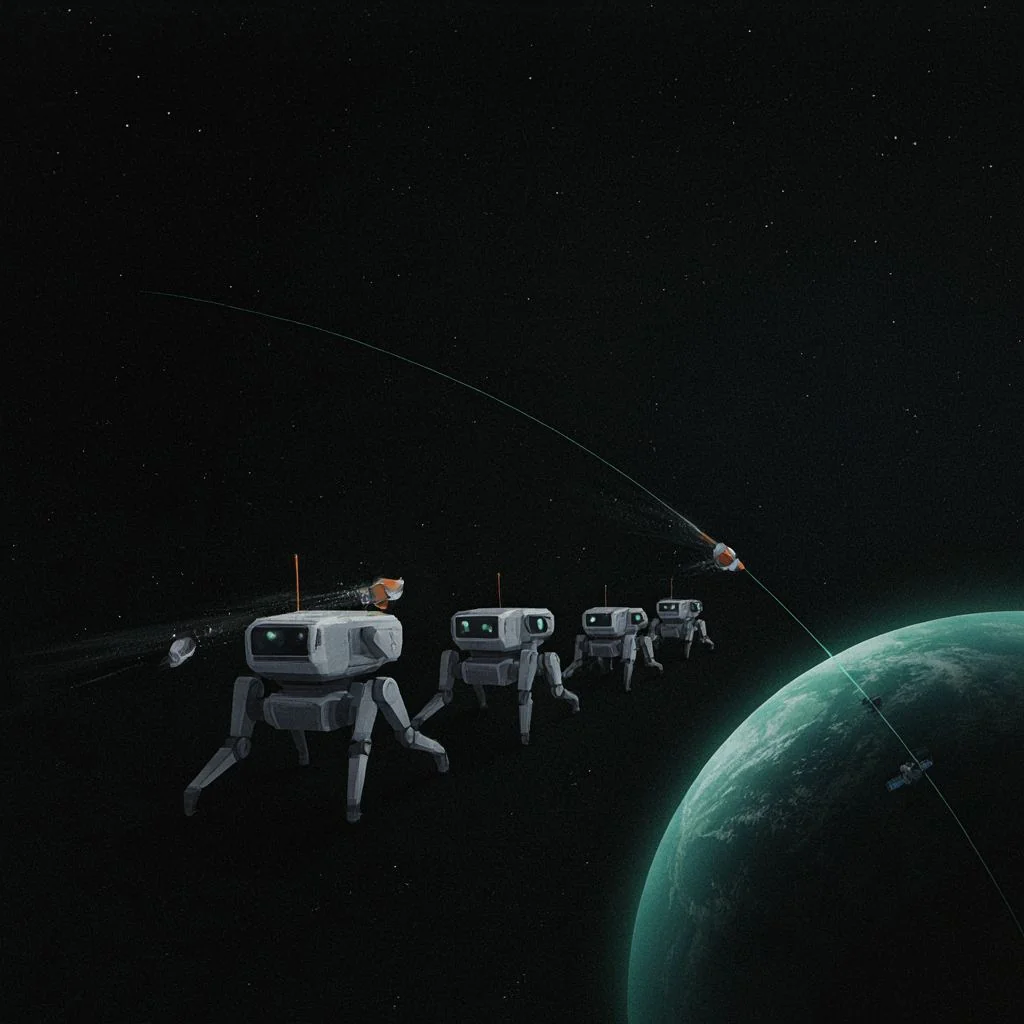
The Star-bots team from the University of Bologna tested a swarm of five autonomous robots for ESA Academy to actively remove space debris.
In brief
Students from the University of Bologna tested, with ESA's support, a swarm of five autonomous robots that surround and chase a free-floating object, to see how they can contribute to active space debris removal.
Key points
- The Star-bots team from the University of Bologna was selected for the 2026 edition of the ESA Academy Experiments Programme.
- The experiment involves a swarm of five robots that surround and follow a free-floating, non-cooperative object.
- In the test three real objects are joined by three virtual ones on screen, to simulate a large-scale swarm with feedback from real hardware.
- Active debris removal consists of grabbing unusable objects and altering their orbit so that they burn up in the atmosphere.
- The tests took place in ESA's Orbital Robotics Laboratory at ESTEC, in the Netherlands.
- The platforms float on a micrometre-thin air gap, which eliminates friction and replicates space dynamics in two dimensions.
A swarm of five autonomous robots that surrounds and chases a free-floating object: this is the experiment with which the Star-bots team from the University of Bologna tackles the problem of space debris. ESA presented the experiment on 15 October 2026. The students were selected for the 2026 edition of the ESA Academy Experiments Programme, which offers access to testing facilities and technical assistance, and put their system to the test in the agency’s Orbital Robotics Laboratory at ESTEC, in the Netherlands, as recounted in the project sheet published by ESA.
Italian students chosen by ESA
The Star-bots team is one of the teams selected by the European Space Agency (ESA) for the 2026 ESA Academy Experiments Programme. The programme provides students with professional testing facilities and technical support. It allows them to verify their ideas on real hardware rather than only in simulation.
The space debris problem
The number of non-functioning objects in space is growing, according to ESA. Some are satellites that have reached the end of their life or run out of fuel; others have collided with other objects, breaking into smaller pieces. The answer the Italian team is working on is called active debris removal. It is a space cleanup process that consists of grabbing unusable objects and altering their orbit. This way the debris re-enters the atmosphere and burns up.
The swarm of five autonomous robots
The experiment involves a swarm of five robots operating together. The robots surround and follow a non-cooperative object, one that does not assist in its own capture, which floats freely. For the test, the students use a combination of real and virtual platforms: the physical setup includes three objects, and the screen displays three more, virtual ones, alongside the originals.
“To test our system we are using a combination of real and virtual robotic platforms, which must all operate together autonomously. This approach allows us to simulate the behaviour of a large-scale swarm while keeping the feedback from the real robotic hardware,” explains Carlo Dallara, a member of the team.
Real and virtual platforms must operate autonomously as a single system. The choice makes it possible to study collective behaviour on a large scale.
Testing at ESTEC
The tests took place in ESA’s Orbital Robotics Laboratory at ESTEC, the agency’s technical centre in the Netherlands. Each floating platform has air bearings at its base that blow air onto an extremely flat floor. This creates a micrometre-sized gap. The platforms float without any friction. This simulated state of free, weightless floating, in two dimensions, faithfully reproduces the dynamics of space.
Sources: