Space explained
Optical Communications: From Earth to Cosmic Discoveries
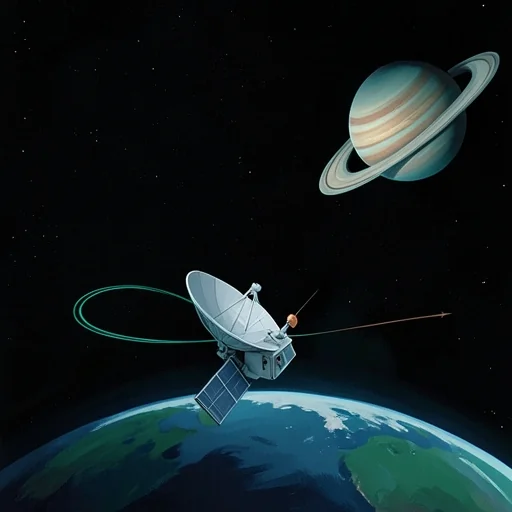
At the heart of this progress, optical communications are emerging as a crucial pillar, uniting basic research with future missions and the understanding.
In brief
NASA is merging decades of aeronautical and space research with optical communications to power cosmic discoveries and future missions. From terrestrial test planes to images of distant galaxies, efficient data transmission is crucial. The MAX POWER expo will demonstrate how these innovations are shaping the future of aerospace.
Key points
- NASA's flight research, initiated in the 1940s, laid the groundwork for aerospace innovation, from aviation safety to space technologies.
- Optical communications, tested in 2024 and validated by the Artemis II mission, are crucial for transmitting large volumes of data for future exploration.
- Cosmic discoveries, such as the Tarantula Nebula image and the 12-billion-year-old galactic merger, heavily rely on the ability to collect and analyze data from multiple telescopes.
- The MAX POWER expo, in November, will showcase next-generation aerospace technologies to the public, including aircraft, spacecraft, and plans for lunar bases.
- Collaboration among NASA research centers ensures continuity in the development of technologies crucial for future missions and understanding the universe.
- Innovation in communications is key to unlocking the next chapters of human exploration and understanding the cosmos.
Space exploration and aeronautical innovation have always demanded an incessant search for new methodologies and technologies. The ability to collect, transmit, and analyze data is fundamental for every step forward, from aviation safety to the most remote cosmic discoveries. At the heart of this progress, optical communications are emerging as a crucial pillar, uniting basic research with future missions and the understanding of the universe.
An example is the composite image of the Tarantula Nebula, or 30 Doradus, released on August 11, 2026.
NASA, with its vast heritage, demonstrates how work carried out in laboratories and terrestrial skies translates directly into space capabilities. This interconnected path illustrates an important point. The development of advanced data transmission systems is vital. It is crucial for the safety of commercial flights and for the observation of distant galaxies.
From Terrestrial Flight to Space Infrastructure
The history of NASA’s flight research is rooted in the work of the Glenn Research Center. This center is located in Cleveland and has been operating since the 1940s. This research laid the groundwork for many current space capabilities. The center was initially the Aircraft Engine Research Laboratory. It conducted flight tests during World War II to improve the performance and reliability of high-altitude aircraft. The center made the first jet engines and ramjets practical in the mid-1940s. These pioneering programs demonstrated the importance of connecting laboratory theory with practical applications, a lesson still valid today.
For almost forty years, Glenn’s Twin Otter has been a cornerstone. It has supported research on in-flight icing. The data collected has shaped modern aviation safety standards. In addition to improving safety, flight tests have explored new propulsion technologies. For example, the hydrogen system for the Martin B-57B Canberra aircraft. It was safely tested between February and April 1957. It demonstrated the reliable operation and advanced efficiency of this fuel. Air capabilities were extended to support space technologies. A program initiated in 1963 tested the efficiency of solar cells. This was done under space conditions, using modified aircraft such as Learjets.
The relevance of this historical research extends to modern communication needs. In 2024, the Glenn Research Center’s flight operations participated in an optical communications study, employing the center’s Pilatus PC-12 NG aircraft. This mission successfully demonstrated the ability to transmit large volumes of data via a laser communication system through NASA’s existing infrastructure. This technology is fundamental for future missions. The Artemis II mission tested optical communications. It transmitted a large amount of data from the Orion capsule to ground stations during its ten-day journey. The transition of the Glenn Center’s flight operations to the Armstrong Flight Research Center has been a significant development, with Glenn continuing research on icing, propulsion, and communication technologies.
Distant Horizons and the Imprint of Cosmic History
The need to transmit and analyze massive volumes of data becomes evident when looking at the discoveries that allow us to understand the universe. An example is the composite image of the Tarantula Nebula, or 30 Doradus, released on August 11, 2026. This vibrant view combines data from four space observatories. These are the Chandra X-ray Observatory and the James Webb Space Telescope. It also includes the Hubble Space Telescope and the Spitzer Space Telescope, now decommissioned. The Tarantula Nebula is located in the Large Magellanic Cloud. This is a small galaxy near the Milky Way, 160,000 light-years from Earth. The nebula hosts thousands of young stars in a honeycomb structure of gas and dust.
The analysis of this combined data allowed astronomers to determine that the Tarantula Nebula may be losing energy from several sources, including hot gas escaping the nebula. The ability to collect and merge this complex data from different instruments is a critical capability, like those developed and tested by NASA. No less impressive is the revelation, on August 17, 2026, of an ancient galactic merger. According to Orbita, this artistic concept depicts a collision between our Milky Way and a dwarf galaxy, LKH, which occurred approximately 12 billion years ago.
A study provided definitive evidence of this merger. It was based on Hubble telescope data and was published in Nature Astronomy. According to Orbita, it extended our knowledge of the Milky Way’s history by 1.8 billion years. These observations of such remote and imposing events underscore the importance of efficient and reliable data transmission. Without the ability to send precise images and measurements to Earth, discoveries that rewrite cosmic chronology would remain impossible.
The Future of Aerospace and New Communications Frontiers
The impact of these innovations will be visible to the public. This will happen during MAX POWER, a new exhibition and airshow. The event will be held on November 7 and 8 at the Kennedy Space Center in Florida. The event, celebrating America’s 250th anniversary, will feature next-generation aircraft, spacecraft, autonomous vehicles, and technologies that will define the future of air and space transportation. NASA Administrator Jared Isaacman emphasized a point. He said that the Kennedy Space Center is “America’s gateway to the stars.” Many of the nation’s greatest achievements began there.
MAX POWER is not just a celebration of the past. It will be a showcase of the future. There will be technology demonstrations and exhibits of NASA hardware. Plans for returning to the Moon and for a lunar base will be discussed. This event unites NASA’s legacy with the companies and technologies that are shaping the future, inspiring the next generation of explorers. The MAX POWER expo offers a tangible look at how these innovations, from laser communications, are shaping the future of aerospace.
The integration of advanced technologies, such as the laser communication systems tested in 2024 and on the Artemis II mission, is fundamental to realizing this vision. It allows not only for sending data from the depths of space but also for supporting the complex logistics and operations of future lunar and Martian missions. The continuity of research, such as that conducted by the Glenn Research Center in collaboration with Armstrong, ensures that the technical foundations for these ambitions remain solid. The fusion of historical research, cosmic discoveries, and future vision highlights a clear path. Innovation in communications is key to unlocking the next chapters of human exploration and understanding the universe.
Sources: