Discoveries
Mars cloud forms ice without dust, a possible planetary first
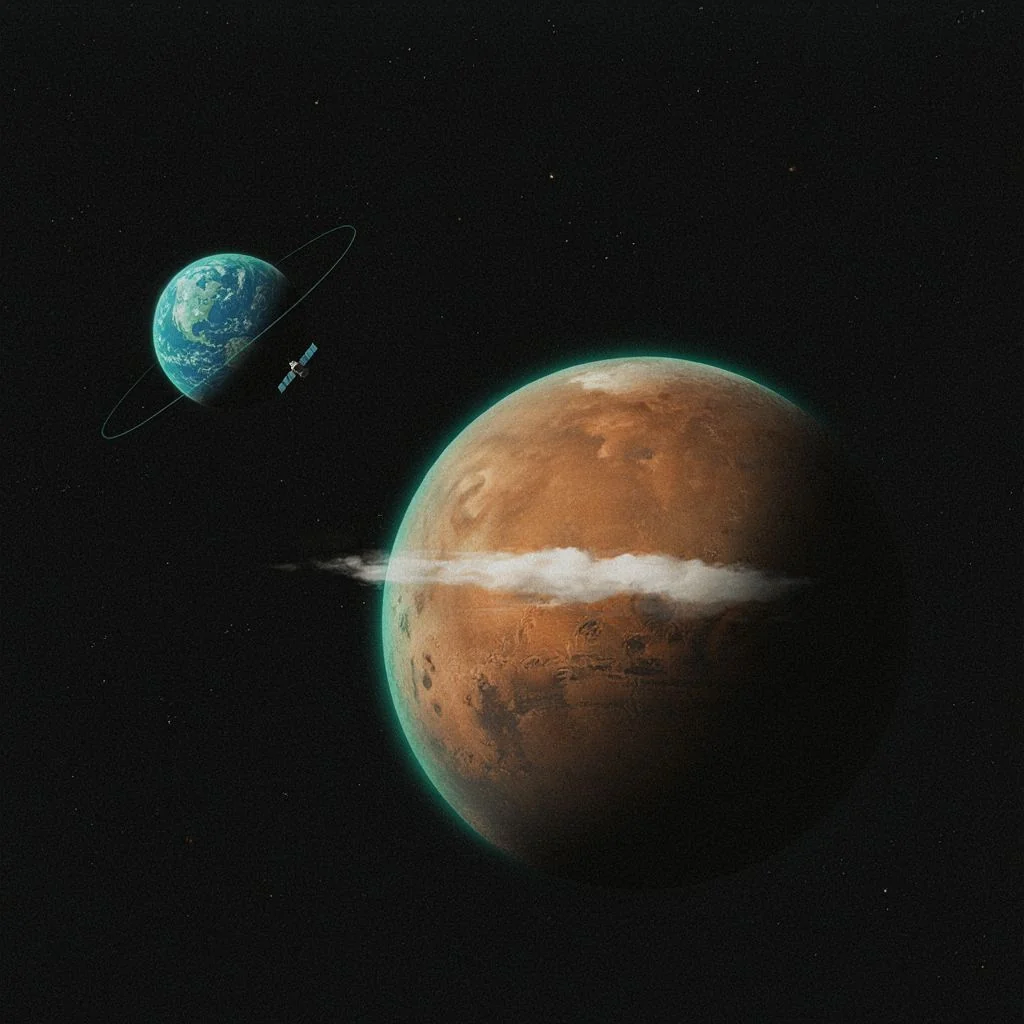
Every morning, for a few hours, a long white cloud forms over the Martian volcano Arsia Mons, a phenomenon that atmospheric models could not explain.
In brief
The long water-ice cloud that appears every morning above the Martian volcano Arsia Mons finally has an explanation: according to a study published in Nature Geoscience, under conditions of extreme cold and supersaturation water vapor forms ice directly, without dust nuclei, a process never convincingly observed in nature.
Key points
- The Amec cloud forms on the western flank of Arsia Mons at an altitude of about 45 km and can extend for up to 1800 kilometers.
- The study led by Jorge Hernández-Bernal of Sorbonne Université was published in Nature Geoscience.
- In the simulations the temperature drops below 130 kelvin, with extreme supersaturation of water vapor.
- With heterogeneous nucleation on dust alone, the model reproduces the waves, but not the observed cloud.
- The simulated cloud remains narrower, starts about an hour and a half later, and is shorter than the one seen by Mars Express.
- It remains to be understood whether the process also occurs in other planetary clouds and in the upper layers of Earth's atmosphere.
Every morning, for a few hours, a long white cloud forms over the Martian volcano Arsia Mons, a phenomenon that atmospheric models could not explain. A study led by Jorge Hernández-Bernal of Sorbonne Université has been published in Nature Geoscience. The research proposes the key to the mystery: water vapor would freeze directly, with no need for dust nuclei. The discovery concerns the so-called Arsia Mons cloud, known to researchers as the Arsia Mons Elongated Cloud, or Amec.
The elongated cloud that forms every year above Arsia Mons on Mars
The Amec cloud forms every morning on the western flank of Arsia Mons, in the Tharsis region. It sits at an altitude of about 45 kilometers, more than twice the cruising altitude of a commercial airliner. It is made of water ice, stays relatively narrow, and can stretch downwind for up to 1800 kilometers, roughly a quarter of the diameter of Mars. Then it detaches from the volcano and vanishes within a few hours.
The phenomenon repeats every spring and summer in Mars’s southern hemisphere, for several months. Its formation is linked to atmospheric waves generated by the volcano’s relief, capable of rapidly lifting air masses and cooling them. The problem is that the very long tail observed in images was always missing from the models.
Homogeneous nucleation: the key to the mystery
To understand the unusual solution, one must know how clouds normally form. Water vapor almost never condenses on its own: it needs tiny suspended particles, such as salt or soot on Earth, and above all dust on Mars. That is heterogeneous nucleation. In homogeneous nucleation, by contrast, ice forms directly from the vapor, without nuclei: a process known in theory. But it requires extremely low temperatures and extreme supersaturation, and was considered nearly impossible in planetary atmospheres.
According to the simulations, Arsia Mons creates exactly those conditions. The atmospheric waves lift humid air by several kilometers within minutes. On the western slope, the temperature can drop below 130 kelvin, about minus 143 degrees Celsius. At that point the vapor forms hundreds of ice particles per cubic centimeter directly. The westerly winds drag them away and give rise to the cloud’s tail. The ice is born without dust: from water vapor alone.
Confirmation from observations and limits of the model
The proof of the model comes above all from Mars Express observations. The spacecraft is one of the few in Martian orbit capable of observing during the morning hours, when the Amec is present. Images from the Visual Monitoring Camera and the High Resolution Stereo Camera provide a term of comparison for the simulations. Data from the Omega spectrometer also serve this purpose.
The result is clear: with heterogeneous nucleation on dust alone, the model reproduces the waves and the low temperatures, but not the observed cloud. Adding homogeneous nucleation brings out the elongated tail, the detachment from the volcano, and even some variations in brightness. The authors also tested the hypothesis of dust particles smaller than 100 nanometers. But in the simulations they produce diffuse hazes, not the thin tail seen by Mars Express.
The model nevertheless remains imperfect. The simulated cloud is narrower and starts forming about an hour and a half later. It also reaches a length shorter than the real one.
Future prospects
The open question is how exceptional the phenomenon is. Does homogeneous nucleation occur only above Arsia Mons, or does it also take part in the formation of other planetary clouds? And could it play a role in the uppermost layers of Earth’s atmosphere, where similar conditions have been predicted but are difficult to observe? For now, the Amec remains a natural laboratory suspended above the volcano: an ephemeral cloud that could force a revision of the general theory of clouds.
Sources: