Space explained
Extreme debris disks: timing, composition and collision clues
The same idea guides the use of James Webb in the study of extreme debris disks.
In brief
Observing rare phenomena, from ephemeral fire clouds to distant planetary collisions, critically depends on identifying and exploiting specific time and spectral 'windows.' Planning and synchronizing airborne and space instruments are essential to capture these events and reveal the secrets of planetary formation and extreme atmospheric phenomena.
Key points
- October 2026 offers several opportunities for astronomical observation, including Saturn opposition and the Orionid shower.
- Pileus clouds, indicators of vigorous atmospheric convection, are rare and short-lived phenomena that require precise timing to document.
- The James Webb Telescope has identified two types of extreme debris disks (silica-rich and silica-poor), which reveal the nature and energy of past planetary collisions.
- Only 1% of young stars show extreme debris disks, making observation windows crucial.
- Synchronization of airborne and space sensors is essential to capture and understand transient events, whether celestial or atmospheric.
- Planetary collisions, like the one that formed the Moon, are phenomena that can be studied indirectly through the composition of debris disks around other stars.
Autumn opens windows for observing the sky that link naked-eye phenomena, fire-generated clouds and distant planetary collisions. The word windows here refers to the times and spectral bands in which instruments measure otherwise invisible changes. This article strings together the October dates for observing Saturn and meteors, the airborne interception on August 11 of a pileus over a pyrocumulus and the James Webb results on 21 extreme debris disks. Time, composition and synchronization determine what can be successfully measured. Planetary Collisions are one of the distant processes revealed by these debris disks.
When seasonal windows allow targeted measurements of extreme debris
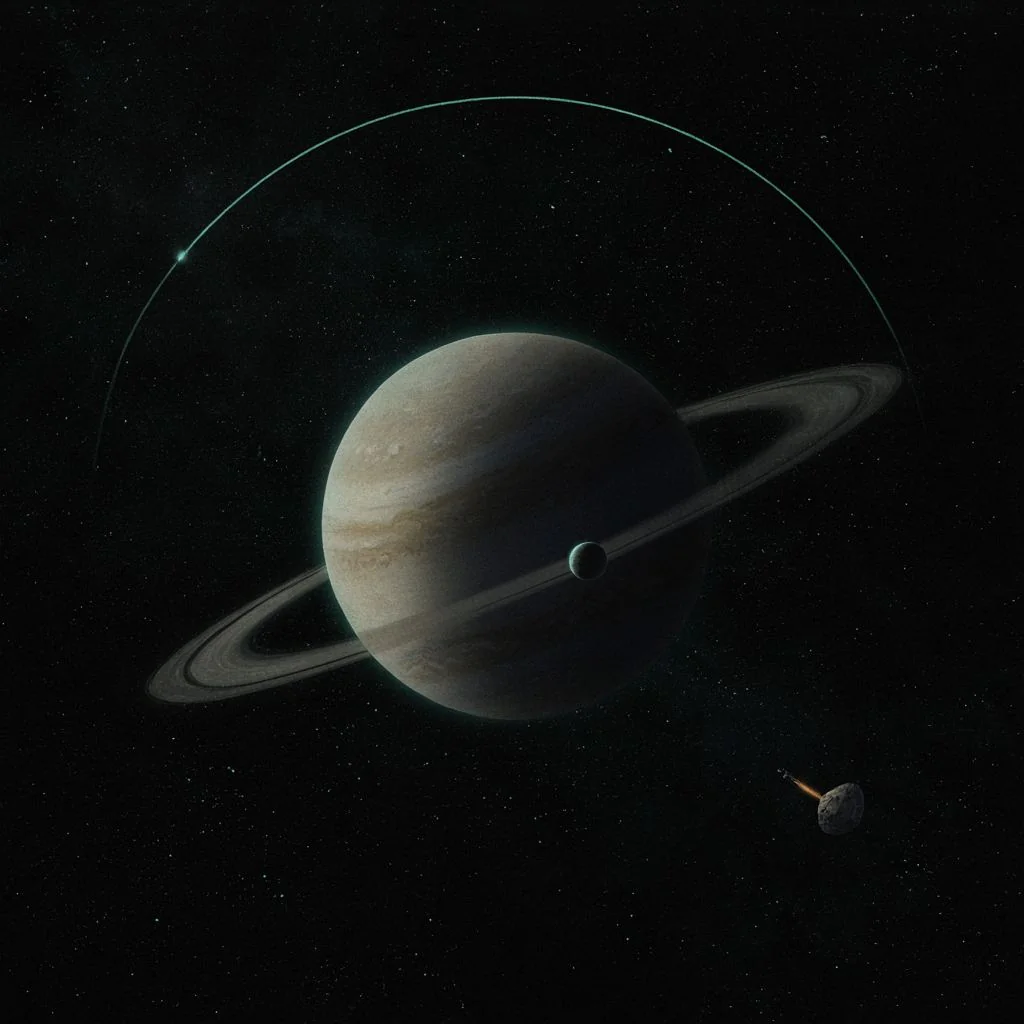
October presents clear opportunities to observe the sky. Saturn reaches opposition on October 4, making it visible for much of the night. Earth positions itself between the Sun and the ringed planet. Saturn rises at sunset and remains in view. Astronomers have long known about an almost 32,000-kilometer-wide hexagonal jet at Saturn’s north pole. The Hubble Space Telescope revealed last month a ten-sided atmospheric wave surrounding the planet’s south pole. This feature of the southern hemisphere appears to be strengthening, offering scientists a rare chance to observe the development of a gigantic atmospheric pattern.
On October 6, a thin lunar crescent will appear near Jupiter before dawn. The Orionid meteor shower peaks on the night of October 21-22. The Orionids are created by tiny debris left by Halley’s Comet. The light of a bright waxing Moon could wash out some of the fainter meteors. The best viewing time is a few hours before dawn, after the Moon sets. The Moon will pass near the Pleiades star cluster, also known as the Seven Sisters, on the night of October 27-28. The Pleiades appear as a slightly fuzzy grouping of 6 or 7 stars, visible to the naked eye.
The same idea guides the use of James Webb in the study of extreme debris disks. The team assembled a sample of 21 systems for compositional and evolutionary comparisons. Of these, 16 were observed with Webb and 5 come from the Spitzer telescope archives. Only 1% of young stars show signatures of this phase, that is one in a hundred, making the windows during which these disks brighten precious. The rarity of cases imposes timing on observations and prioritization of favorable dates. Studies of Planetary Collisions hinge on catching those moments when debris reveals collisional history.
Temporal windows determine what can be successfully measured. A few days or hours can decide whether a phenomenon is recorded.
When a fire cloud opens a very brief window
During the INSPYRE campaign (Injected Smoke and Pyrocumulonimbus Experiment) researchers overflew the Sand Creek fire in Montana. On August 11 they intercepted a pyrocumulus, a fire cloud, topped by a pileus. The pileus is a smooth, veil-like cloud. It forms when ascending air columns heated by the fire encounter a sufficiently moist layer of air aloft. The updraft lifts the moist air upward. This cools the air and condenses the water vapor. Researchers, like Neil Lareau, explained that the pyrocumulus itself acts like a “mountain” that forces convection.
The pileus lasted only a few minutes, a sign of very vigorous convection. The decisive image was taken at 17:40 local time, that is 23:40 UTC, by the MASTER (MODIS/ASTER Airborne Simulator) sensor aboard an ER-2 research aircraft. MASTER recorded the convective column in 50 channels and acquired images about every 30 minutes. The pileus was visible in a single acquisition. The short-wave infrared (SWIR) bands showed active combustion points. This allowed linkage of fire-front dynamics to the formation of the convective plume.
This coincidence among visual, infrared and radar airborne sensors created a unique window on the transition from fire to cloud. The presence of the cloud suggests extreme updraft dynamics within the fire plume. The pileus is a rare phenomenon to observe in detail interacting with a fire cloud. Such clouds can also form from strong updrafts associated with thunderstorms and volcanic eruptions, as observed on Sarychev Volcano in 2009.
Comparing the brevity of the pileus with the astronomical windows clarifies a practical point. Very rapid events require appropriate acquisition timing and coordination among platforms. Transient events remain invisible if observers miss the right moment. The lesson applies to faint meteors and to fleeting phases of debris disks. The lesson also applies to clouds that exist for only minutes.
Composition, variability and how to read planetary collisions
Observations with James Webb and Spitzer have revealed that extreme debris disks share three key characteristics. They have smaller dust grains than protoplanetary disks or classical debris disks. They show a high concentration of warm dust. Finally, they exhibit irregular brightness variability. The disks often show rapid changes in brightness. The sample studied splits into two groups based on their mineral composition: about one third are silica-rich and two thirds are silica-poor.
The presence of silica indicates high-energy impacts. These impacts are comparable to collisions between Mars-sized bodies, where a significant fraction of material is vaporized. Silica-rich materials, like volcanic glass obsidian, are also found on Earth. Silica-poor disks, instead, indicate collisions on smaller scales, such as grazing impacts between Moon-sized objects. The mineral forsterite, poor in silica, appears as green sand grains on some Hawaiian beaches.
These silica-poor disks persist across a broader age range and often show greater variability. This variability is likely driven by the rapid evolution of fresh debris through orbital changes and additional impacts. Webb’s mid-infrared spectral observations have enabled identification of these compositions, directly linking composition to the energy and history of the impact. We have no other way to study these planetary embryos directly, because they are too small. These data can be applied to our own solar system, which may have experienced more than one phase of extreme debris disk. Evidence of past Planetary Collisions can thus be read in mineral signatures.
Mineral composition translates collision energy into an observable sign. Abundant silica means impacts with extensive vaporization.
Synchronize instruments, reduce missed events
The link between the three stories is practical: knowing astronomical windows, mobilizing airborne flights and pointing telescopes in the right spectrum increases the probability of recording rare events. The combination of airborne and space observations increases the information obtainable. To reduce the number of unobserved events requires more coordinated campaigns among airborne sensors, space telescopes and ground observatories. This enables “connecting and mapping the dynamics from surface fire to convective plume to cloud processes,” as highlighted by the INSPYRE campaign.
Open questions remain. How many bright phases of disks slip by because there are no observations at the right time, and how many pileus remain unphotographed due to their brevity? Working on windows also means investing in sensors that cover more bands and in programs that can respond rapidly to transient signals. The next step is to extend the duration and coverage of campaigns to better connect images to the stories that spectra tell. Time, composition and synchronization will continue to define what the sky allows us to see.
Planning and synchronizing observations saves rare events. More coordination between air and space is needed to decrease missed events.
Sources: