Space explained
Celestial Rhythms Guide Global Space Exploration
Humanity has always looked to the sky, seeking to decipher celestial rhythms and, through space exploration, extend its presence beyond Earth's confines.
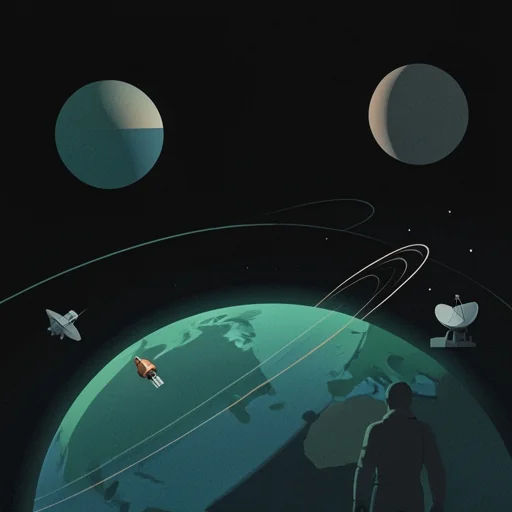
In brief
Space exploration unites the understanding of terrestrial equinoxes with the Mars missions of the Perseverance rover and Artemis lunar plans, highlighting international collaboration between NASA and JAXA and the importance of inspiring future generations to continue pushing the boundaries of science.
Key points
- The Perseverance rover captured a 360-degree panorama of 'Turquoise Bay' on Mars, using 818 images between October 5 and 16, 2023.
- Equinoxes occur twice a year, in March and September, when the center of the Sun crosses Earth's equatorial plane, illuminating both poles.
- NASA's Johnson Space Center engaged over 3,000 people at the 33rd Japan Festival, presenting the Artemis III mission and plans for a Lunar Base.
- Collaboration between NASA and JAXA is fundamental, with Japan having signed the Artemis Accords and developing lunar hardware.
- Inspiring new generations through public events and meticulous scientific precision are crucial for the future of space exploration.
- The length of day and night is not exactly equal during an equinox due to the spherical nature of the Sun and atmospheric refraction.
Humanity has always looked to the sky, seeking to decipher celestial rhythms and extend its presence beyond Earth’s confines. This intrinsic curiosity continues to drive Space Exploration, from understanding fundamental astronomical phenomena to the ambition of establishing outposts on other worlds, uniting scientific precision with collective commitment.
NASA’s Johnson Space Center engaged over 3,000 participants.
Cosmic Rhythms and Planetary Exploration
Celestial cycles, such as equinoxes, were among humanity’s first astronomical observations, with ancient observers tracking their passage. An equinox occurs twice a year. This happens in March and September. It marks the exact moment when the center of the Sun crosses our planet’s equatorial plane. During an equinox, the Sun equally illuminates both terrestrial hemispheres, a phenomenon that allows the North and South poles to be simultaneously exposed to sunlight. This fundamental principle of illumination and shadow also guides robotic missions.
The same attention to astronomical detail is crucial for the exploration of other celestial bodies. NASA’s Perseverance rover is on the planet Mars. It used its Mastcam-Z camera to capture a 360-degree panorama. This panorama is of a geological area called “Turquoise Bay”. This vast mosaic was composed of 818 images. The images were acquired between October 5 and 16, 2023. This occurred during Martian days 933 and 944 of the mission. Analysis of these images provides vital data on the Martian environment. Some images have enhanced colors to accentuate visual differences. This echoes the precision needed to understand celestial phenomena even on our own planet.
Deep Exploration and the Artemis Mission
Robotic discoveries like those by Perseverance on Mars are not ends in themselves, but prepare the ground for the next phase of human exploration. NASA is planning a return to the Moon. It collaborates with international partners for the Artemis III mission. The long-term vision includes a Lunar Base. These ambitious projects were presented at the 33rd Japan Festival. The event was held in Houston. NASA’s Johnson Space Center engaged over 3,000 participants. The event showcased models of the Orion spacecraft and the International Space Station, offering visitors the chance to try on an astronaut glove and helmet.
The enthusiasm generated by these initiatives is palpable, especially among young people. Brendan King is a software engineer. He works for the Flight Dynamics Division at the Johnson Space Center. He expressed astonishment at seeing high school students so passionate about NASA. This passion is fueled not only by the prospect of lunar missions, but also by the understanding that space science is a continuously evolving field of study and discovery. The equinox does not result in a perfect equality between day and night. This is due to the spherical nature of the Sun and Earth’s atmospheric refraction. This subtle scientific complexity inspires the same curiosity that drives engineers to design complex spacecraft.
Global Collaboration for Space Science
The drive towards exploration is a global endeavor, as demonstrated by the close collaboration between NASA and JAXA, the Japan Aerospace Exploration Agency. JAXA exhibited a model of the HTV-X1 cargo vehicle. It also showed images of its pressurized rover at the Japan Festival, alongside the NASA booth. The rover is designed to support future crewed and uncrewed missions to the Moon. JAXA astronaut Akihiko Hoshide met the public, signing autographs and posing for photos, solidifying the bond between the agencies.
This collaboration extends to significant partnerships, such as the addition of the Kibo laboratory aboard the International Space Station and Japan’s signing of the Artemis Accords. These accords define principles for peaceful cooperation in lunar exploration and beyond, emphasizing how space science transcends national borders. The shared understanding of universal phenomena, such as the Sun’s passage over the equator during the equinoxes, strengthens the bond between nations. This aids in the pursuit of new knowledge and preparation for future challenges.
Inspiring New Generations and the Future of Exploration
The commitment to disseminating science and exploration, as done at the Japan Festival, is crucial for inspiring future generations of scientists and engineers. Joy and excitement were visible on the faces. Children and adults explored NASA’s exhibits. This was a highlight for Johnson Space Center employees. These public events offer a unique opportunity. They allow sharing NASA’s history, ongoing work, and future missions. This makes concrete the idea that “great leaps” begin here on Earth.
Meticulous attention to detail, both in capturing Martian panoramas and predicting equinoxes, is the foundation of every advancement in space science. The March 2026 equinox is predicted for 2:46 PM UTC on March 20. The September one is predicted for 12:05 AM UTC on September 23. Their precise determination requires a deep understanding of celestial mechanisms. This precision is applied to space travel and life on other worlds. It will continue to push the boundaries of knowledge and stimulate curiosity. This ensures that exploration never stops.
Sources: