Earth and climate
Mars and the Beehive Cluster shine under an aurora in NASA image
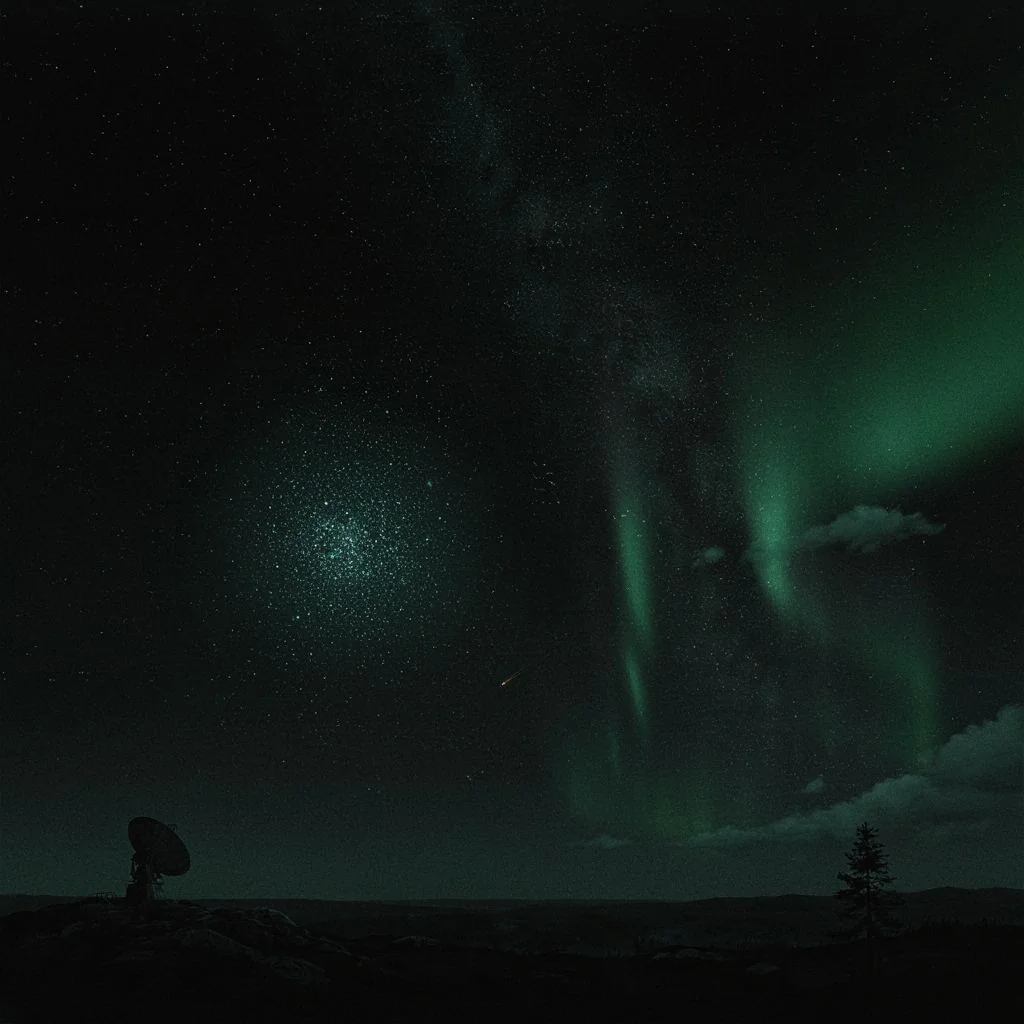
NASA publishes the image of Mars and the Beehive Cluster under a northern lights aurora, caused by the solar eruption that reached Earth on October 10, 2026.
In brief
NASA's Astronomy Picture of the Day series showed on October 14 and 15, 2026 two night images: Mars and the Beehive Cluster under an aurora caused by a solar eruption that arrived on Earth on October 10, and a Milky Way above Manhattan made visible with a filter that blocks visible light, since LED lamps are dark in the near infrared. The next image, announced for October 16, is dedicated to the International Space Station.
Key points
- The solar eruption reached Earth on October 10, 2026, causing strong disturbances of the magnetic field and the aurora photographed in Sweden
- Mars appeared by coincidence almost at the center of the Beehive Cluster, also called M44 or Praesepe
- The stars of the Beehive Cluster helped astronomers understand that they rotate more slowly as they age
- The Milky Way above Manhattan was photographed with a filter that blocks visible light and captures only near infrared
- LED and fluorescent lamps remain almost invisible in the near infrared, while incandescent lamps and neon signs still shine
On October 14, 2026, NASA published on Astronomy Picture of the Day the image of Mars and the Beehive Cluster under a curtain of northern lights, taken near Lansjärv, Sweden. The next day, October 15, the same series devoted its photo to the Milky Way above Manhattan, obtained with an infrared filter. Two images, two nights, one same message from the editors: the sky remains accessible even where it seems impossible to see. The Swedish aurora is signed by Petr Horálek of the Institute of Physics in Opava, with Josef Kujal and Vojan Höfer. The New York photo carries the signature of Jason Kurth and Ty Buckley.
Where the aurora above Sweden comes from
The aurora in the image is the direct result of an eruption on the Sun. The ejected material reached Earth on October 10, 2026, causing strong disturbances in Earth’s magnetic field. These are the geomagnetic storms also described by NOAA Space Weather. The energetic particles from the eruption collide with molecules in the atmosphere and charge them with extra energy. The molecules then release that energy as colored light: this is the mechanism that paints the luminous curtain above the trees in the photo.
The meeting between Mars and the Beehive Cluster is, however, a pure coincidence of position. Mars appeared almost at the center of the Beehive Cluster, also known as M44 or Praesepe, right around the time of the shot. The two objects have no physical connection: they simply lie along the same line of sight from Earth.
What the Beehive Cluster really hides
Despite the name, the Beehive Cluster contains no bees. It is a swarm of young stars, visible to the naked eye as a hazy patch. Its scientific value has long been known. The rotation periods of its stars helped astronomers understand that stars spin more and more slowly as they age. These bodies lose mass through their stellar winds, and the slowing of rotation marks the passage of time. That is why measuring how fast a star spins helps estimate its age, as explained by research gathered by Harvard’s Center for Astrophysics.
In the image, the aurora is not a decorative detail, but the sign of a real solar event. The editors’ curiosity is that the sky over Lansjärv brings together three stories at once: a geomagnetic storm, a planet, and a star cluster.
How the Milky Way is seen above Manhattan
On October 15, the chosen photo tells a different challenge. In New York, city lights overwhelm the stars. The editors open the explanation with a question: who would ever have thought the Milky Way could be visible in that sky? The answer lies in the filter used for the shot. The filter blocks most of the visible light and captures only the near infrared, a band of light with lower energy than what the human eye perceives.
The trick works because light pollution sources are not all equal in that band. LED and fluorescent lamps remain almost invisible in the near infrared. Old incandescent bulbs and some neon signs still shine in that region of the spectrum. Stars, which are bright even in the near infrared, remain clearly visible. The result is a Milky Way above Manhattan that the naked eye would never see: a selective vision, built by the physics of the spectrum.
What these images leave out
Both photographs have limits acknowledged by the editors themselves. In the Manhattan photo, the incandescent and neon lights remain in the shot. The image does not match what an observer would see with the naked eye. In the Swedish photo, the coincidence between Mars and the Beehive Cluster is only apparent. The link with the aurora is one of position in the sky, not of physical origin. These are two reconstructions of the sky, not two neutral records.
The series continues with an appointment already announced for October 16, titled “Chasing the ISS”, dedicated to the International Space Station. The editors of Astronomy Picture of the Day, a NASA service together with Michigan Tech University, close with the broader value of the operation. We all live under the same sky, and astronomy allows anyone to better understand humanity’s place in the cosmos. In Sweden, the Sámi, the indigenous people of the Arctic regions, call the auroras guovssahasat and traditionally observe them with respect.
Sources: